
Being indispensable is bad for business.
If every decision runs through you, the company eventually runs out of your time. Meanwhile, the decisions that could get it growing again compete for whatever attention you have left.
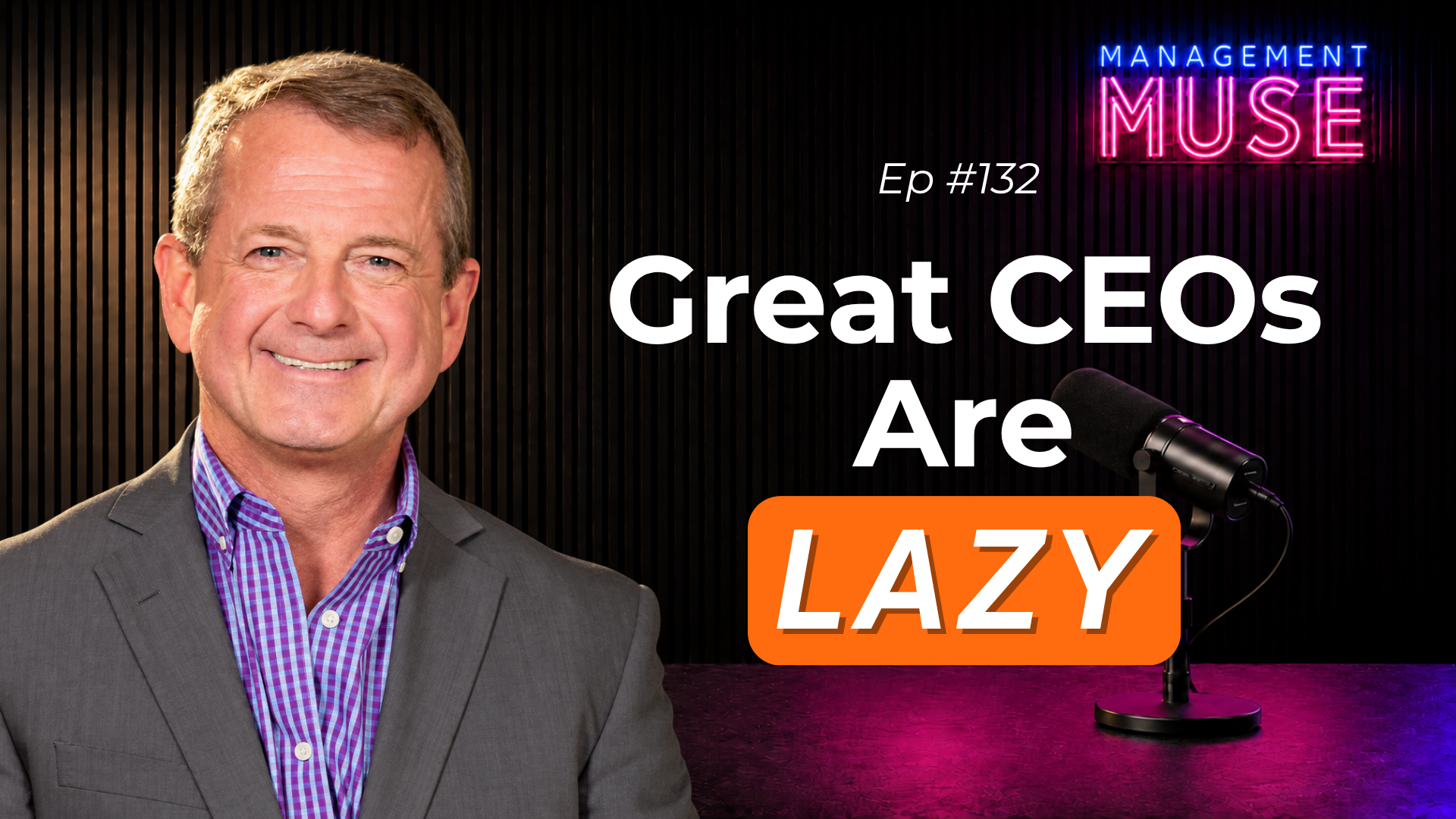
Jim Schleckser of The CEO Project, author of Great CEOs Are Lazy, joins Cindi Baldi to explain why effective CEOs make room to do less. In Jim’s framework, the flat stretches between periods of growth signal a constraint: something in the business model, talent, or systems that needs attention. The challenge is identifying a problem you can actually address, rather than stopping at a limitation affecting everyone (like tariffs), and recognizing when your own involvement is part of it.
You’ll learn Jim’s three-D model—defer, delegate, don’t do—for clearing lower-impact work; his 70% rule for handing over responsibility; and how experience, risk, and reversibility should shape the oversight you provide. Cindi and Jim also discuss why always being present can weaken an organization, and how the group mind can help leaders work through problems they don’t have to solve alone.
*Jim has his own podcast! Tune in to the The CEO Project Podcast here.
What you’ll learn about business growth, constraints, and CEO bandwidth:
- You’re working 70 hours. What happens when the business doubles? How the CEO’s bandwidth becomes the company’s growth limit.
- Busy fixing everything except what matters? How to find the main constraint holding your business back, and identify what you can actually change.
- Waiting until someone can do it as well as you? Jim’s 70% delegation rule and three Ds—defer, delegate, don’t do—help you decide what to take off your plate.
- Does the business need an Architect, Coach, or Engineer? How to recognize which leadership role the problem calls for.
- What if the best idea isn’t yours? Why CEO peer groups can reveal solutions you wouldn’t reach alone.
- Your presence may be weakening your team. How being involved in every decision keeps employees from developing their own judgment.
Watch This Episode on YouTube:
About Jim Schleckser:
Jim Schleckser has spent more than 30 years as a CEO and operating executive, including serving as president of Spirent Communications and on boards across multiple industries. He founded the CEO Project to give mid-market CEOs a confidential peer group and coaching platform for better big-bet decisions. He is the author of the book Great CEOs are lazy, and host of the CEO Project podcast.
Connect with Jim:
The CEO Project Peer Groups | The CEO Project Podcast | Book: Great CEOs Are Lazy | Linkedin
The Uncertainty Playbook: 14 Strategies for Work Success in a Chaotic World:
→ Get your copy here.
Get Science-Backed Insights and Exclusive Perks Straight to Your Inbox:
→ Sign up for our newsletter and get a FREE chapter of The Uncertainty Playbook.
Want to Go Deeper? Check Out Our Recommended Reading:
- Surowiecki, James. The Wisdom of Crowds, Vintage, Aug. 2005, https://link.amazon/B0iVR7T2M
- Oncken, William and Donald Wass. “Management Time: Who’s Got The Monkey?”, Harvard Business Review, Nov. 1999, https://store.hbr.org/product/management-time-who-s-got-the-monkey/99609
Join Our Community & Follow Us:
Questions about business constraints and CEO capacity answered in this episode:
Why does business growth plateau, and what counts as a constraint?
Jim Schleckser describes the flat stretches on a scalloped growth curve as periods when a constraint limits further progress. In his framework, the useful diagnosis is a limiting factor specific to your business that you can address. External factors like tariffs or political conditions may require a response, but naming those conditions alone doesn’t establish what your company specifically has the power to change.
What is the CEO “switchboard operator problem”?
The “switchboard operator problem” occurs when all key information and decisions must pass through the CEO. As the company scales, demand for the leader’s attention exceeds their available time. Jim Schleckser argues that this dependence can delay work, restrict employees’ development, and crowd out the few vital decisions that most need the CEO’s judgment.
What are the three Ds for freeing a leader’s time?
Jim Schleckser’s three Ds are defer, delegate, and don’t do. He recommends ranking activities by economic impact, drawing a line halfway through the list, and picking one of the three Ds for everything below it. The purpose is to create capacity to address the business’s most important constraint.
What is the 70% rule of delegation?
Jim Schleckser’s 70% rule recommends delegating a task when someone can do it about 70% as well as you can, rather than waiting for them to match your ability. It does not mean abandoning oversight. The person’s experience, the decision’s risk, and its reversibility determine whether they should seek approval, provide advance notice, or report afterward.
Problem, Diagnosis, Solution: A Practical Application
Business growth has stalled. What should you investigate, and what should you stop doing?
The following exercise applies ideas from Jim Schleckser’s conversation with Cindi Baldi on Management Muse. The illustrative scenario is not a client case from the episode.
Management problem: You want more customers, but your calendar is already full
Imagine your business needs more new customers. You’re attending additional sales meetings, reviewing proposals, and approving discounts. Your workload is growing, but customer acquisition isn’t improving.
Before adding another initiative, write down the result that is falling short. “We need more customers” identifies the outcome. It doesn’t yet explain what is preventing it.
Diagnosis: The same symptom can require three different responses
Jim’s three CEO hats offer different ways to investigate the problem:
|
Where to investigate |
Questions to ask |
CEO hat to wear |
|
Business model |
Are we targeting customers who need this offer? Does the pricing make sense for them and for us? |
Architect |
|
Talent |
Do we have the right sales leadership and skills? Can the team explain the value of the offer? |
Coach |
|
Processes and systems |
Where do leads or proposals stall? Are unnecessary approval steps delaying progress? |
Engineer |
The question is: What evidence would help us distinguish between these explanations?
What managers can do: Turn the diagnosis into a change you have capacity to make
Choose one change to investigate first. State the suspected constraint, the result you expect to improve, and what you will look at to judge whether the change helped.
Make room for that work. Review your calendar and task list. Identify one activity to postpone, one responsibility to hand over, and one activity to stop. Specify where the recovered time will go.
Set the terms of the handoff. If an employee will take over proposal reviews, for example, agree on which decisions they own, which require approval, and when they should update you. Match those boundaries to their experience and the consequences of a mistake.
Before your next planning meeting, try completing this sentence:
“We think ______ is limiting ______. We will investigate it by ______. To make room for that work, I will ______.”
Full Episode Transcript:
Jim Schleckser (00:00)
You’re weakening your organization if you’re always present. We’ll talk to CEOs sometimes and they’re working, 70 hours a week, right? All right, got it. You’re you’re tough. What do you do when it doubles? Are you gonna work 140 hours a week? Is that the plan? What defines us either as an individual or as a company is what we say no to. It’s not what we say yes to. If they’re 70% as good as you are, delegating immediately.
Cindi Baldi (00:26)
Hey everyone, thanks for joining me today on Management Muse. I’m your host, Cindi Baldi, and today we’re gonna talk about why the lazy CEOs can be the best ones. I have the fabulous Jim Schleckser and he has a great book. It’s called Great CEOs Are Lazy. Jim, he works with CEOs and companies to help them identify the constraints that are blocking them from being able to, you know, really grow dynamically. And so that’s the root of your effort and your work.
And so with that in mind, do you have a good story that you could share about like maybe a company that like you you got in there and found that constraint? Do you have like of your favorite story about your work?
Jim Schleckser (01:11)
yeah, we’ve got a couple I mean we’ve got a bunch, but a couple of good ones. We had one member we work with who sold information technology to the government primarily, and he had a really poor business model. It was a hundred and fifty million dollars of revenue and he made maybe two million dollars. Like so it was a lot of work to make a couple million bucks. Not that that’s anything to sneeze at and a lot of risk, right? Moved a lot of volume through. And the distribution model, this was not sticky, had no recurring revenue in it, it took a lot of risk as you indicated, and low margin. All the bad things we don’t like in business model. So over time we helped him modify his business model to be more of a designed product with long term maintenance strings on them and long term contracts. So he upped the percentage of recurring revenue massively because it was relatively proprietary product, the margins went up.
And this business just recently transacted for just a little over five hundred million dollars. So he did very, very well for himself. Well as a result of that change in the business model that we helped him with. And that is what we call the architect cap is working on your business model.
Cindi Baldi (02:20)
Okay. And so that’s where you’re looking for the constraint is in the business model?
Jim Schleckser (02:23)
Well, it’s the constraint can lie in one of three areas. it can either lie in the business model, the talent you have around the business, or the processes and systems you use to run the business. And we talk about the CEO wearing one of three hats when we’re working in those spaces, the architect hat for business model, the coach hat for talent, and then the engineer hat for processes and systems. So those are the three places where CEOs get the most leverage is find that point of constraint and open it up.
And the model, the analogy we use is think about a garden hose and the kink comes into the garden hose. You can’t get water out of the hose because there’s a kink in it. So your job is to find the kink and open it up. And actually work anywhere on the hose except for the point of the kink. Nothing
That same thing’s true in your business. Somewhere in your business there’s a point of constraint, a kink in the hose. And our job as CEOs is to find the kink and open it up. And if you do that, you think about this historic model they show you an MBA school of scalloped growth curves where you grow and you go flat and you go up and you get flat. That flat spot they didn’t talk about this, I don’t think they understand this, but that flat spot is the point of constraint coming in.
Cindi Baldi (03:35)
I don’t think that they have it narrowed down that precisely.
Jim Schleckser (03:38)
But it that’s what it is. It’s any system that looks like that. There’s a point of constraint. And when I clear the point of constraint, I get to grow again. So that’s that’s
Cindi Baldi (03:46)
That’s a good insight.
Jim Schleckser (03:46)
the model. That’s the model that that we work with CEOs on. And it’s really effective. There’s a lot of CEOs get in the job and they go, I’m not actually a hundred percent certain what I’m supposed to be doing. We’re not supposed to say that, but that is true. And this gives them a mental model of where should I spend my time by the constraint book.
Cindi Baldi (04:04)
Do you actually hear CEOs say that?
Jim Schleckser (04:07)
you’ll hear things like, I don’t know to who to go to for help. it’s the biggest company I’ve ever run before. I was I know when I was in sales, I knew exactly what to do and how to do it and when to do it. In this job, you know, not as much, right? And you see them struggling a bit trying to find their footing in a job that they were never trained to do. That happens all the time. All the time. And whether whether it’s you’ve jumped in or you grew up from zero and you now you’ve got to deal with it.
Cindi Baldi (04:36)
Well, yeah, sure, growing it from zero, you still wind up hitting the plateau of what you did right. Yep. And so you you do have to have like sort of that reassessment. And I’m just curious because, you know, we have such a an image of leadership where you’re supposed to be sort of all knowing, you’re supposed to have the answers, be decisive. It’s really a messed up image of leadership. I mean, at least in the extreme.
Jim Schleckser (05:05)
Yeah, it it causes bad behavior because as leaders we don’t feel like we can be vulnerable and say, hey, ladies and gentlemen, I’m not 100% certain what to do here. I think I got some ideas, but I’d love to talk it out. And they go, no, the captain on deck doesn’t know what to do, what direction to send the ship? Yikes. Well, they’re human. I know they’re capable, but they’re human as well. And sometimes you don’t know. And that that’s where we we do CEO peer groups. We help CEOs work themselves through that. Instead of having to do it in public, they can do it private.
Cindi Baldi (05:35)
So Jim, what lessons have you learned from having this peer group?
Jim Schleckser (05:39)
yeah, so we have a dozen peer groups around the country, actually thirteen that with CEOs in them. I’d say the biggest thing I’ve learned about leadership and being a CEO through the peer group business is it it’s not a one person sport, particularly as you get to a certain size. you could think you think about it like a network problem. if there are 10 points around a circle, how many connection points do you have available? How many connections can be made?
And the answer is n times n minus one divided by two. So 10 times nine divided by two, 45. Or what if there was a hundred? And just think about this as people, 10 people, 100 people, 100 people. How many connections are there? You go, well, I don’t know, 10 times as many? No, no, no. 4,950. So it’s a it’s a it’s a geometric problem of complexity. And so maybe you could run it when it was 10 or 20 million, but when it gets to 50 or 100 million, it you you it’s not a one-person job anymore. It’s too complex. and
Peer groups, my answer is, you know, I will always bet on the group mind. I mean, I’m pretty good at this and I always I come up with good ideas, but every time I go to one of these CEO peer groups, somebody chewing and the group chews on a problem that somebody has, I go, dang, that’s a great idea. You should do what they’re saying because I never would have thought of it. And I’m humbled by it all the time.
Cindi Baldi (06:59)
I totally hear you on that. Even with teaching, you know, we used to teach in universities and you know, a concept I’ve taught dozens of times before. And some student raises their hand and asks a question and sees it from like a completely different angle. And you’re like, Wow, I had never really thought about it that way, but now I am. What are great CEOs deliberately not doing that mediocre CEOs are doing?
Jim Schleckser (07:28)
Yeah. I think what the I talk about what defines us is either as an individual or as a company is what we say no to. It’s not what we say yes to. Yes is easy. No is hard. So really hard, right? And you gotta feel like you’re gonna disappoint somebody or so in order to create the time to focus on the point of constraint, all the you’ve got to look at everything that you’re doing. And some of these things have to go overboard. You just can’t do them anymore.
And when you see a CEO spending seventy, eighty hours a week, they’re saying yes to everything. They think they have to be in their room. Their presence makes the meeting important. They need to know what’s going on in every case. But as a company scales, that model doesn’t work anymore. It works when it’s twenty, thirty, fifty people, but not when it’s five hundred.
Cindi Baldi (08:12)
And even then it barely works.
Jim Schleckser (08:14)
I concur. Because we talk about it as you know, delegation and allowing people to figure it out and do the work actually grows organizational capacity. So you’re weakening your organization if you’re always present. Yeah, mommy or daddy’s always at the table to solve the problems. That that weakens an organization doesn’t strengthen.
Cindi Baldi (08:33)
It also I think sends a a message to employees that you either don’t trust them or don’t think that they’re capable. And then you’re not then they’re being defensive in terms of, okay, I’m gonna have to clear everything through this person before I feel like I I’m not gonna take that risk.
Jim Schleckser (08:51)
Yep. Well and that and that’s one of the fatal flaws we see with CEOs or even at high level managers. We call it the switchboard operator problem. So you imagine the old days you’d call into a a business and there’d be usually it was women in those days with a big switchboard, they’d Hello, we’re calling for Mr. Jones and they’d take the the cable and they’d plug it into Mr. Jones’ phone and his phone would ring and then Mr. Smith.
And you go, Okay, well that’s great up to a hundred calls an hour, but what about two hundred? What about five hundred? What about a thousand calls an hour? And the answer is if there’s only one switchboard operator, meaning the CEO and everything goes through the CEO, you run out of their time. I have we would talk to CEOs sometimes and they’re working, 70 hours a week, right? all right, got it. You’re you’re tough, you get it, you’re strong, you can do it, you don’t wear out. What do you do when it doubles? Are you gonna work 140 hours a week? Is that the plan?
They immediately see how ridiculous their model is.
Cindi Baldi (09:48)
We have we’ve had CEOs, obviously we discouraged them from this, but they had this mentality and it like one that stands out who is a super nice person, but it almost seemed like it was a badge of honor at to the point where health problems were coming into play, like you know, going down in the middle of a work day and still persisted to like just keep everything sort of tightly controlled by him. So it it is it’s a real problem.
Jim Schleckser (10:23)
Well, and I and I think it all all things come from your your youth experience, unfortunately. But I think in this case it’s a complete lack of self confidence. I’m so afraid of failure, meaning I depend on somebody and they fail that I don’t have the confidence to trust them and let them do the work. And I and it’s a really hard thing to overcome if you if that’s built into your DNA. How do you overcome trust and confidence?
Cindi Baldi (10:47)
I think I I think you’re right that there are many times where it could be confidence. I think in this case it was sort of that Puritan ethic at work. You know, where you if you if you have any downtime, then like you’re lazy in a bad way. Like you know, you’re you’re promoting the opposite. You’re like, hey, be lazy in the smart way. So you’re saving your resources for like the good stuff, the important stuff, the high impact stuff.
And we like anyway, sometimes people just can’t come around to that.
Jim Schleckser (11:23)
Yeah, no, I actually there’s a good quote from Jeff Bezos. funny enough, one of my clients said it as well. He goes, I make four to six decisions a year that really matter. The problem that’s what Bezos says. So he’s tries to focus all his effort on those four to six critical decisions. The the corollary to that, which is came from my client he is, the problem is I’m not completely certain which ones they are when I make So if it seems like it could be one, I gotta spend the time on it, right?
Cindi Baldi (11:52)
That that’s a good s that’s a good segue for my next question, which is you know, how what do you suggest they do to decide what they’re paying attention to and what they’re getting rid of?
Jim Schleckser (12:05)
Yeah. So on the not side first, we recommend you take the list of all the things you’re doing, stack it up, rank it the best you can in economic impact on the business, whether it’s risk mitigation, big risk mitigation or big upside, a big margin improvement, something number numerically driven, rank it and then make a line about halfway up that list. Everything below the line, you either defer into the future and hope time solves it, which happens more often than you’d like to admit. It turns out not to be a big problem. Right.
Delegate it aggressively to somebody who’s 70% ready to take it, give it to them, or literally don’t do it. And and I can tell you that and I’m a list guy. Sometimes I know I’ve already done something I was supposed to do. I’ll write it on my list and cross it off just so I get credit for it. Because you get this little endorphin hit when you cross something off a list.
Cindi Baldi (12:56)
Absolutely. That’s especially if you’re achievement oriented, like I took a shower, check, okay, my day’s going in the right order.
Jim Schleckser (13:03)
Right. And same thing’s true on like I just decided I’m not going to do that. Line through it, done, you get a little endorphined hit. So and I’m going to say if you do that and then do it again a month or two later, maybe even another another month or two later, you will create immense amounts of time on your calendar because you’re going to stop doing all these so silly things you weren’t doing you were doing before and was consuming your time and your energy. And you can focus them on, find the point of constraint and open it up and really do the job there.
So the the what to spend time on is a point of constraint. That’s clear. What not to spend time, you need this three D process of delegate, defer, don’t do your to do list. And that’s the har that’s the harder piece. I can give you my bet my best advice.
Cindi Baldi (13:43)
Let’s have it. Best advice.
Jim Schleckser (13:45)
It’s this I’m known for this, gosh. Who knows why? But it’s called the 70% rule of delegation. And the idea is if somebody’s many CEOs look at somebody they’re thinking about delegating to and they go, Well, she’s not as good as I am at it. And and to which I say, you know, that’s not a fair comparison point. You are a special human being. You’ve got gifts, you’ve got talents, you’re probably reasonably bright. That’s why you’re in this job, right? I you don’t put a dummy there.
And so to compare yourself your you as the standard, you got a very high bar. It also means if you’re waiting for somebody to be as good as you are at a task, you will never delegate, which I think is a trap a lot caught in. So what I talk about is you if they’re seventy percent as good as you are, delegate immediately. And and what it does is it gives a controlling person, CEO, whatever, gives them permission to delegate at a far lower level than they would organically if we didn’t give them a model like that.
And what you find is when you delegate, people get smarter. They do the job they get elected and work. Well, let me change it this way, this way, this way. Especially if they’re high performers, they’re not going to mess it up two times the same way. They’re going to get better over time. And shockingly, they might be as good or better than the CEO at that particular job. Now, to be fair, when we do delegate at the 70% level, we don’t, it’s not abrogation, it’s delegation. So we don’t abdicate our responsibility to go, hey, take care of it.
Don’t even let me know what you did. That is abdication. People think that’s delegation. It’s terrifying. But there are levels of delegation. You go, well, hey, go check it out. Come back and talk to me and I’ll decide. At least you’ve outsourced the research, right? Up up to a higher level of like, go look it up, go figure it out, come up with a plan. Tell me what you’d like to do, and I’ll give you a yay or nay. Out to, you know, go figure out what you want to come up with a plan, shoot me a note. If I don’t say no within 24 hours, just go do it. Right. Up to
Hey, go do it. Go figure it out. Do it. Just let me know what you did afterwards. I’m not going to get involved in the decision process. You’re going to do it. I’ll just just let me know what you did so I know. That’s
Cindi Baldi (15:48)
Right. But everybody has to build to that.
Jim Schleckser (15:51)
Right. And we consider experience of the person. if they’re highly experienced, we can go up a little faster. If they’re little green bean newbie, we we go a little slower. And we look at the ri the risk and reversibility of the decision being made. So if it’s an irreversible or let’s say hard to reverse, because everything’s reversible, including bad tattoos, right? So everything’s reversible, given that you’re right in your rearest beef beats I should mention that. Yep. so irreversible decisions or what we we’ll go slower on those. We don’t delegate those quite as quickly.
Reversible decisions, we delegate pretty quickly. the other one is risk. how big is the risk, right? Let’s say we’re going to consider changing the name of the entire company and rebranding the whole thing. Well, that’s a pretty risky decision. We go slow on that one. Or we’re going to open up Europe and to plow a bunch of money to open up Europe. Risky decision. We don’t delegate that one quite so quickly. what food should we serve at the company barbecue? Company picnic.
Hard delegate and then just you go figure it out. Actually, you don’t even need to let me know what you decide, just decide, right? So that that risk and reversibility has to come into how aggressively and me and capability the person goes into how fast we go. But 70% rule of delegation, that is the secret sauce to get stuff off your desk. When you’re asking how do you clear the desk, how do you make time for it? That that rule is really, really important.
Cindi Baldi (17:12)
And and so, okay, what do CEOs most commonly think is a constraint, but it’s not really a constraint? they they think it’s a constraint, but it’s not really, and then how do you uncover the constraint? Yeah.
Jim Schleckser (17:26)
So the the classic mistake that people make is they’ll say something like, What’s the point of constraint? They the political environment. And the problem with global elements like that is it’s like rain. It rains on everybody. There’s no competitive advantage or disadvantage from the regulatory environment. Everybody’s facing tariffs. You you’re not at a relative disadvantage. But everybody’s dealing with it.
So that’s not the point of constraint. And the other actually some one CEO said this to me, it’s the current administration. I go, great. What are you going to do to change it? You can go vote, you can maybe lobby some people, but you basically can’t change it either. So a constraint has to be something you can actually get after, you can actually change it potentially. And it’s unique to you, not a global one. Within that, I’m gonna say about probably over 40% of the CEOs we talk to, client acquisition and client growth is the point of constraint.
They want to grow faster and that’s what’s slowing them down.
Cindi Baldi (18:29)
Okay. And I guess probably from there, if if that’s their point of constraint, then you’re probably re examining the business model.
Jim Schleckser (18:36)
Depends. And now we’re digging in, right? It’s it it’s the client acquisition process. Well, all right, is the offer right? Is the pricing right? Are you targeting the right customers? Do you have the right product and service to offer them? Those are all in the kind of business model space. Do you have the right leader running the sales process? Do you have the right salespeople in your organization? Are they well trained to know how to sell the product to the clients you’re after?
And the other and the last one might be, you know, the the way you do your selling process, the way you acquire leads and clients. Now we’re talking about process. So it could be in any of the three once we determine generically it’s in this space within the business. And you might and generally if the outside of business model changes, which are high leverage, it’s generally a process or a talent change in some way.
Cindi Baldi (19:22)
Okay. I was just gonna ask you, you know, how frequently is these constraints actually a function of the CEO?
Jim Schleckser (19:34)
Yeah, it’s an excellent comment because sometimes it is, right? In other words, their behavior and how they and and I put that under talent. It’s a a different category, but we put it under talent of how the CEO is performing and engaging with the business can absolutely be a point of concern. Back to some of things we just talked about, about infomaniacs, all the information has to go through me or control freaks, they keep checking on projects, checking on projects, micromanaging people. those are all really negative behaviors.
If you’re trying to grow a business. So yeah, the CEO can be the point of constraint. And or or sometimes we I’ve got one CEO I I’m working with. And what needs to be done to grow his business is step and he’s got a great business model, he’s got a great target, he’s got a great offer. Just step and repeat. Just keep doing it. The problem is he’s really likes to do it
Cindi Baldi (20:23)
Yeah.
Jim Schleckser (20:23)
up. He’s a twitchy creative type, right? And so the joke goes, what do firefighters do when there’s no fires?
Jim Schleckser (20:32)
And the answer is they become they become arsonists.
Cindi Baldi (20:37)
I know a lot I actually know a lot of firefighters. Believe me, they become cooks.
Jim Schleckser (20:41)
And they cook they do cook. I know you’re right, but but that’s the joke. if there’s no action, I’m gonna go create some action. That’s exactly what he does. And gosh, I talked to his management team, they’re like, my gosh, Jim, if you could just give this guy some lithium or something, just chill him out.
Cindi Baldi (20:56)
All right. It’s that it’s that line between explore and exploit. Yeah. And you know, if you’re not doing enough exploring, I mean, if you’re not doing enough exploiting, which that’s what we’re talking about, is like holding the course, then you’re just constantly laying out money and you’re not actually moving forward financially. Yeah.
Jim Schleckser (21:15)
That’s absolutely true.
Cindi Baldi (21:17)
Alright. Thank you, Jim, for being on the show. Is there anything that you would like to promote?
Jim Schleckser (21:25)
No, well, Cindy, thanks for having me. If somebody wanted to learn more about CEO peer groups and what we do, go to theCEOproject.com and all our propaganda is there. You’re welcome to take a look at it. We’d love to chat with you if it’s interesting to you.
Cindi Baldi (21:38)
Excellent. And I will be on your podcast in short order, the CEO project. Go check it out. He has lots of good advice for leadership and figuring out your constraints.