
The biggest risk of AI isn’t that it will replace us; it’s that it will stunt our growth.
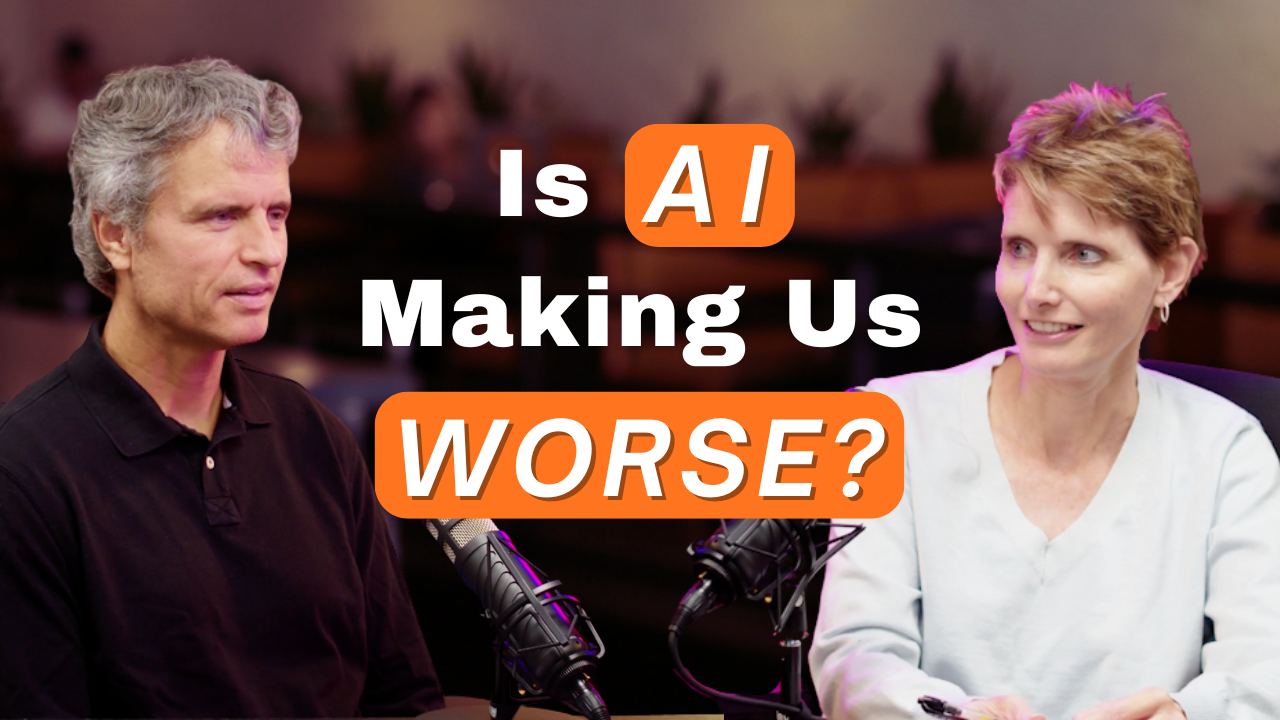
In this episode of Management Muse, Cindi Baldi and Geoff Tumlin explore the rapidly growing belief that artificial intelligence will transform, or even replace, large parts of work and leadership. They argue that this narrative misses something fundamental about how organizations actually function. From decision-making and strategy to coaching and customer service, they unpack where AI actually adds value and where human judgment, relationships, and real-world experience will have true staying power.
The conversation challenges the assumption that more efficiency always leads to better outcomes. In many cases, the moments that feel inefficient—difficult conversations, feedback, mentorship, and trust-building—are exactly what make teams stronger and organizations more resilient. If you want to understand how to use AI without losing the human edge that makes leadership effective, don’t miss this episode.
Episode Highlights:
- How AI distorts self-evaluation
- The risk of removing friction from the workplace
- Upskilling and the future of work
- Why strategy can’t be automated
- The relationship that keeps employees loyal
Watch This Episode on YouTube:
Get your copy of The Uncertainty Playbook: 14 Strategies for Work Success in a Chaotic World here.
→ Use code PLAYBOOK20 for 20% off.
Get Science-Backed Insights and Exclusive Perks Straight to Your Inbox:
→ Sign up for our newsletter and get our FREE guide to the 6 Habits You NEED to Level Up Your Management Skills in 2026!
Want to Go Deeper? Check Out Our Recommended Reading:
- Hau, Isabelle C. “Welcome to the Era of Relational Intelligence,” Stanford Social Innovation Review, 2026, https://ssir.org/articles/entry/era-of-relational-intelligence
- Bjork E.L. & Bjork R.A., “Making things hard on yourself, but in a good way: Creating desirable difficulties to enhance learning,” Psychology and the real world: Essays illustrating fundamental contributions to society, Worth Publishers, pp. 56-64, https://psycnet.apa.org/record/2011-19926-008
Join Our Community & Follow Us: